
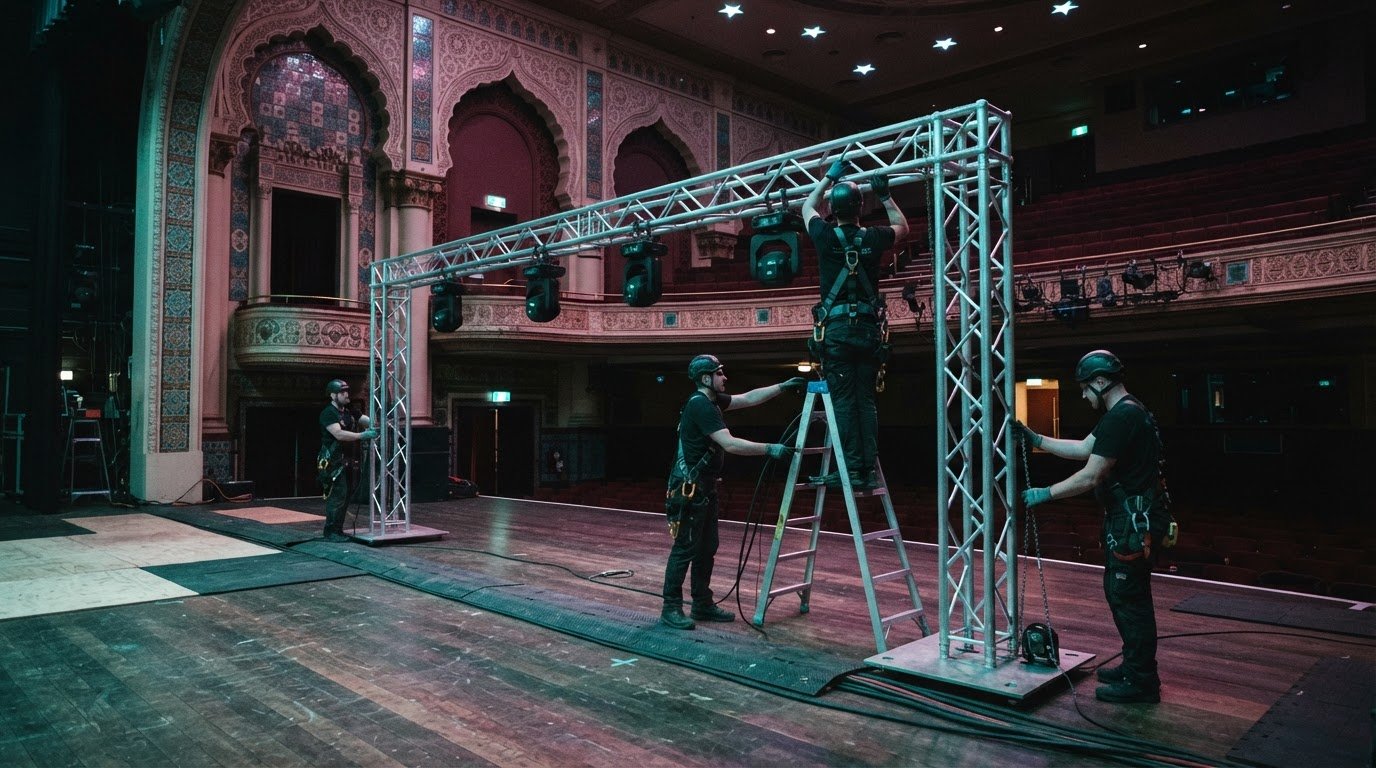
A historic Melbourne venue can give an event a distinctive sense of place, but confined spaces, rooftop locations and restricted access call for careful rigging plans. Rigging solutions for historic venues in Melbourne start with understanding the building, the event design and how equipment can be moved and installed safely.
For heritage settings, access, overhead space, structural information and venue operating requirements all shape the rigging plan. Share these details early so the production team can coordinate the technical design with the venue.
This article explains what professional event rigging involves, how venue constraints influence planning, and what to look for in a rigging partner. You’ll also learn how staging, lighting and other event production elements can be coordinated to support a seamless experience without losing sight of the venue’s character.
Key Takeaways
- Understand what professional event rigging covers in Melbourne and how it differs from hiring a crane alone.
- See how confined spaces, rooftop locations and restricted access shape rigging plans for historic venues.
- Learn what to look for when assessing Melbourne rigging suppliers and matching a system to your venue.
- Discover how coordinated staging and rigging can support the event experience while respecting a heritage setting.
Supply Riggings in Melbourne?
Melbourne and Victorian rigging work can involve planning, fabrication, installation, supervision and load movement. Historic venues add another layer: building structure, heritage fabric and access conditions shape each decision. Planning rigging solutions for historic venues in Melbourne starts with understanding the venue and the production brief.
Rigging and fabrication services
Melbourne and Victorian providers may coordinate event rigging, fabrication and structural steel work as parts of one installation. Fabrication can create project-specific frames or supports, while structural steel services address elements designed to carry equipment. Professionals plan these components around the venue layout, intended load paths and event requirements, then coordinate installation. Look for a clear explanation of how each component serves the event and fits the space.
Historic venue system selection
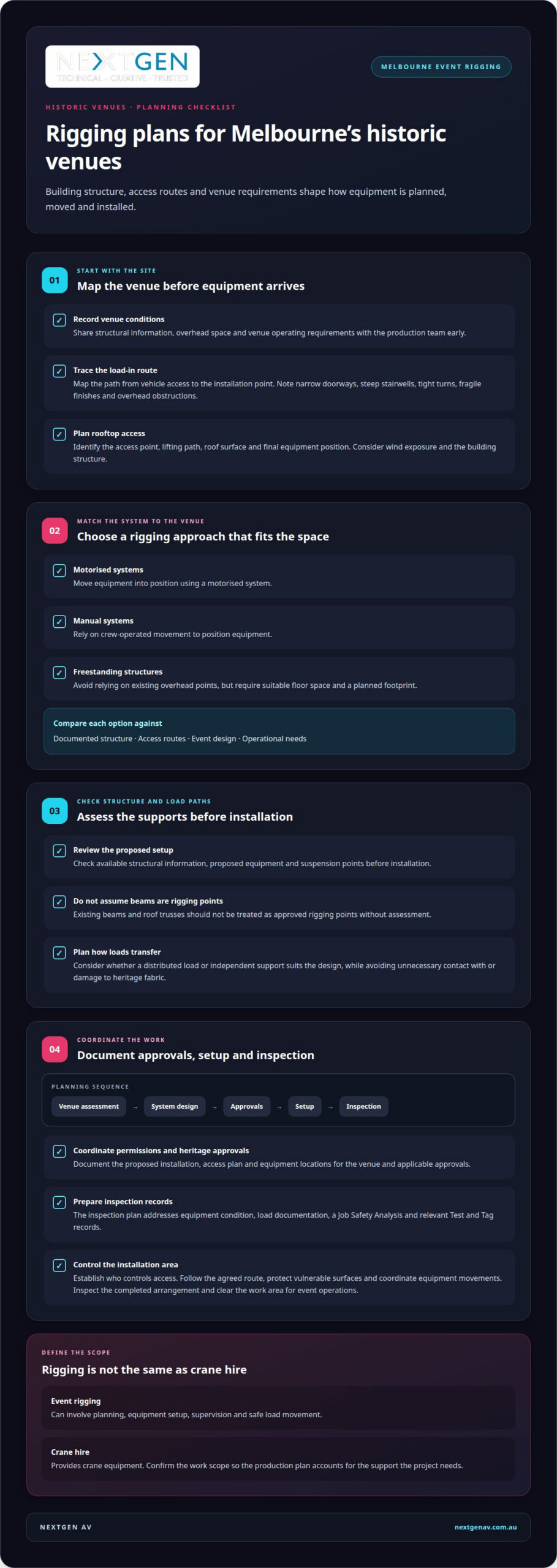
Motorised systems can move equipment into position, while manual systems rely on crew-operated movement. Freestanding structures avoid relying on existing overhead points, but need suitable floor space and a planned footprint. Professionals compare options against documented structure, access routes, event design and operational needs. The right rigging solutions for historic venues in Melbourne depend on the building as well as the production.
Load limits and structural assessments
Before installation, professionals review available structural information, proposed equipment and suspension points. Existing beams and roof trusses should not be treated as approved rigging points without assessment. The plan considers how loads transfer through the structure and whether a distributed load or independent support suits the design. It should also avoid unnecessary contact with or damage to heritage fabric.
Permits and heritage approvals
A rigging provider coordinates venue permissions and applicable heritage approvals by documenting the proposed installation, access plan and equipment locations. The process moves from venue assessment and system design to approvals, setup and inspection. A professional inspection plan addresses equipment condition, load documentation, a Job Safety Analysis and relevant Test and Tag records. Venue technical documents can help identify specialist rigging systems or documented load ratings, rather than relying on assumptions based on a building’s age or name.
Rigging involves planning, equipment setup, supervision and safe load movement. Crane hire is a separate service that provides crane equipment. Confirm the scope of work so the production plan accounts for the support the project actually needs.
Confined-space, rooftop and restricted-access rigging
Historic venues can restrict equipment movement before installation starts. Narrow doorways, steep stairwells and rooftop locations affect the load-in plan, handling sequence and rigging design. Map the route from vehicle access to the installation point, noting tight turns, fragile finishes and overhead obstructions.
To reduce the risk of damage, plan handling routes and contact points before moving equipment. Use assessed rigging positions and appropriate protective measures, rather than attaching equipment to unassessed beams, roof trusses or heritage fabric. A freestanding support, for example, may suit a room where overhead fixing could affect original surfaces.
Restricted access calls for a practical equipment schedule. Break the setup into manageable components, sequence deliveries around the venue layout and keep public and production routes clear. For a stairwell load-in, plan how each item will pass through landings and doorways before moving it.
Rooftop work brings its own constraints. Plan the access point, lifting path, roof surface and final equipment position. Consider how wind exposure and the building structure affect the proposed arrangement. Coordinating arrival, handling and installation helps prevent congestion and unnecessary movement through heritage areas.
Before installation, align the rigging plan with venue requirements and establish who controls access. During setup, follow the agreed route, protect vulnerable surfaces and coordinate equipment movements. After installation, inspect the completed arrangement and clear the work area for event operations.
When access or heritage constraints shape the production, event rigging planning can help align equipment movement, installation and the intended audience experience from the outset.
Melbourne rigging supplier listings
A Melbourne directory page lists more than 10 rigging companies, showing the range of listings available across the city. Named locations include Melbourne, Caulfield South, Sunshine West, Truganina, Epping and Mount Cottrell. The listed distances from Melbourne are 0.8 km, 10.7 km, 12.9 km, 19.6 km, 20.2 km and 34 km respectively. These figures indicate listing locations, not travel times or service coverage.
Location is only one part of the decision. Rigging involves planning, supervision, equipment setup and safe load movement. Crane hire specifically provides crane equipment. A historic venue may need a coordinated rigging plan rather than lifting equipment alone, especially when access routes, roof structures and heritage details affect installation.
For a Melbourne event, the useful next step is to define the actual scope. Is the requirement overhead event rigging, a freestanding support, fabrication, or a crane lift? Is installation limited to a stage area, or does it include equipment movement through restricted access? These distinctions help clarify which capabilities the project needs, without assuming every directory listing covers the same work.
Venue location also affects logistics. A central Melbourne venue and one elsewhere in metropolitan Melbourne each require a delivery and access plan suited to the site. A rooftop installation, for example, involves different planning from a ground-level theatre setup. Coordinate equipment, crew movements and installation with the venue’s constraints.
Use supplier listings as a starting point for understanding Melbourne’s market, not as proof of a particular venue’s suitability. For heritage work, the decisive details are the installation scope, structural assessment, access plan and coordination with venue management. Clear project information helps connect the rigging requirement to the right technical approach, rather than relying on a listing’s location alone.
What rigging systems are suitable for heritage-listed theatres and halls?
The suitable system depends on the venue structure, event design and installation method. In a heritage-listed Melbourne theatre, compare motorised, manual and freestanding options against documented rigging points, access and the equipment plan. A system used in another hall is not automatically suitable.
Motorised systems use powered mechanisms to move suspended equipment, allowing controlled movement during setup or production. They require suitable support and a plan for operation, positioning and control. Manual systems rely on crew-operated movement and may suit arrangements where equipment positions remain fixed. Choose according to the venue’s rigging infrastructure, planned movement and production schedule.
Freestanding systems can be an alternative when overhead points are unsuitable. Assess their footprint and position against the venue layout and usable floor space. In a compact hall, a structure could affect seating or audience sightlines, so the event design and access routes need to work together.
Start with venue plans and technical documentation to establish which support points and systems suit the installation. Consider equipment positions, load distribution, access and restrictions affecting heritage surfaces. Existing theatre bars, for example, should only be considered where venue information supports their use and the planned configuration has been assessed.
Compare each proposal on its connection to the building, the equipment it must support, how the crew will install it and how it affects the audience experience. A clear technical plan should explain the chosen system and its relationship to the venue’s documented structure. That gives production teams a practical basis for coordinating staging, sightlines and event flow without treating heritage details as an afterthought.
For a heritage venue event, plan your staging and rigging around the building’s structure and the experience you want to create.
NextGen AV: Staging and Rigging
NextGen AV coordinates staging and rigging planning for events in Melbourne’s historic venues. Turn to the team when access constraints, heritage details or production requirements call for coordinated technical planning, not equipment alone.
NextGen AV’s Staging and Rigging service is planned around the event layout, venue information and audience experience. The team considers how staging, suspended equipment and production elements fit together, so technical decisions support the programme and respect the venue’s character.
For broader event production, LED Video Walls and Professional Audio Systems can be integrated into the plan. Virtual and Hybrid Event Solutions can connect with audiences beyond the venue. Each element is considered in relation to the space and production brief, with technical direction coordinating the production.
For a historic venue event in Melbourne, contact NextGen AV to discuss your staging and rigging requirements.
Shape the Next Stage
Shape the production brief around the experience you want guests to remember. With rigging solutions for historic venues in Melbourne, consider how technical decisions support the programme, audience flow and venue character. A clear brief gives the production team a focused starting point.
Lighting Design and Equipment can help shape the event’s visual direction while keeping the venue’s distinctive character in view.
Contact NextGen AV about rigging to start planning your production. Your venue’s history can set the scene for an event that feels distinctly its own.
Frequently Asked Questions
Which Melbourne companies specialise in rigging solutions for historic venues?
NextGen AV coordinates production planning with Melbourne venue managers, in-house technical teams and external contractors. For a historic venue, this helps align event requirements with the people responsible for the space and its operations. Share the venue, event date and production brief with NextGen AV to discuss the technical coordination your event requires.
Discover Valuable Insights
Unlock Expert Tips and Advice
Our blog is packed with valuable information to help you stay ahead. Whether you’re looking for expert advice, industry trends, or practical tips, you’ll find everything you need. Reach out today to learn more or get in touch with us for personalised support!